ASML
The Dutch company the entire semiconductor industry depends on
By VastBlue Editorial · 2026-03-26 · 16 min read
Series: Made in Europe · Episode 1
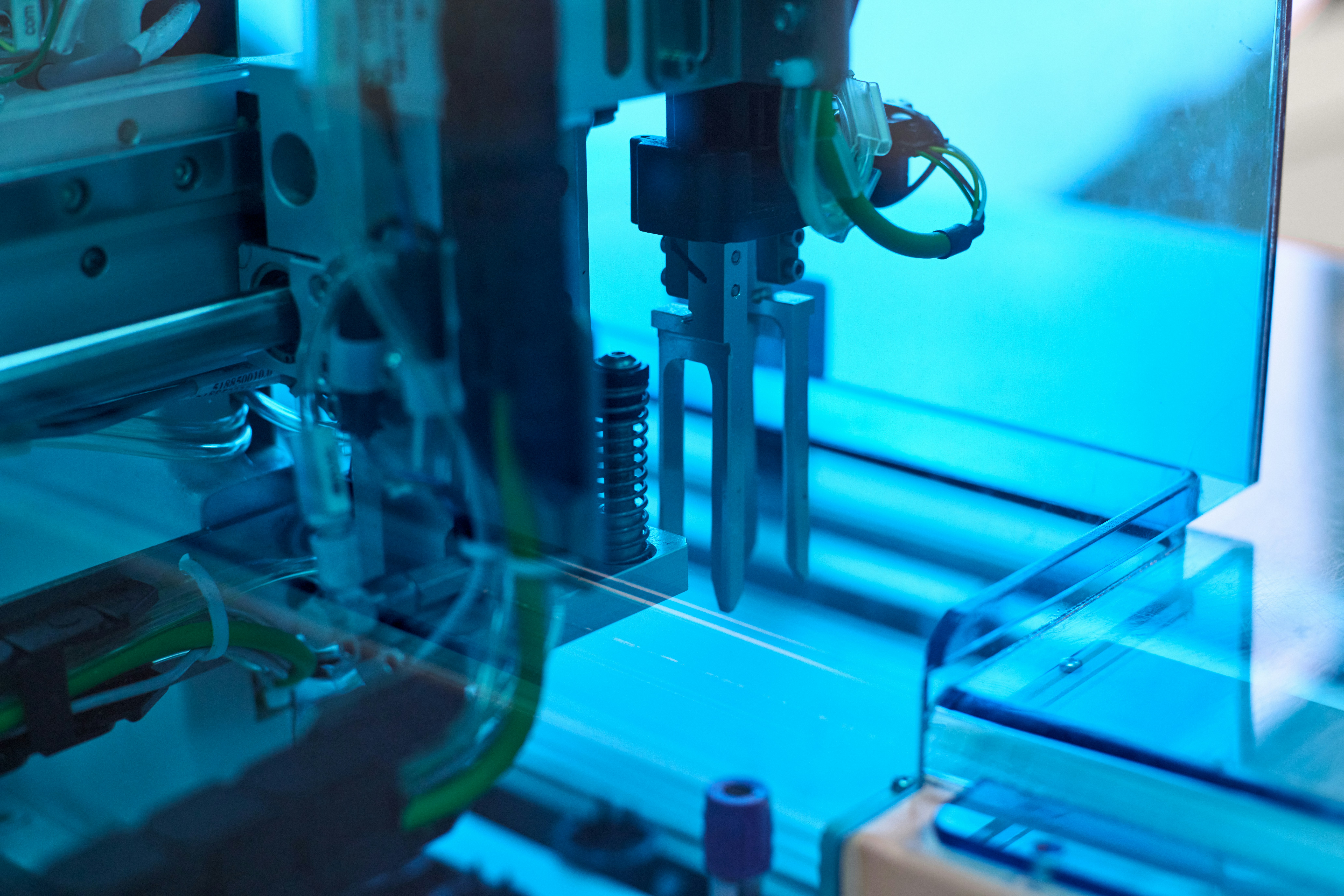
The Machine That Makes the Modern World
There is a machine that costs roughly €350 million. It weighs 180 tonnes. It must be transported in forty freight containers and three Boeing 747 cargo planes. When it arrives at its destination — a semiconductor fabrication plant in Taiwan, South Korea, the United States, or a handful of other locations cleared for delivery — it takes months to assemble and calibrate. It operates in a vacuum, projecting patterns of light onto silicon wafers with a precision measured in nanometres. If it stops working, the most advanced microchips in the world stop being made. There is no alternative supplier. There is no substitute technology. There is no workaround.
This machine is the TWINSCAN NXE, and there is exactly one company on earth that builds it: ASML, headquartered in Veldhoven, the Netherlands. Population 45,000. About an hour south of Amsterdam by car, nestled in the province of North Brabant, surrounded by flat agricultural land and unremarkable suburban housing. The kind of place a tourist would drive through without stopping, on their way to somewhere that seemed more important.
But if you are interested in where the future is actually manufactured — not designed, not imagined, not pitched to venture capitalists, but physically brought into existence at the atomic scale — Veldhoven is the most important town on earth. Because without what ASML builds there, the semiconductor industry as we know it does not function. Full stop.
Printing with Light
To understand why ASML matters, you need to understand how chips are made. Not at the level of a marketing slide — at the level that actually determines whether your phone works, whether your car starts, whether the data centre processing your email query returns a result before you lose patience.
A semiconductor chip is, at its most fundamental, a collection of transistors — tiny switches that can be either on or off, encoding the ones and zeros that constitute all of digital computation. The more transistors you can fit onto a chip, the more powerful it becomes. In 1971, Intel's 4004 processor contained 2,300 transistors. A modern Apple M4 chip contains roughly 28 billion. The surface area of the chip has not changed much. What changed is how small we learned to make each transistor.
Transistors are not assembled. They are printed. The process is called photolithography — literally, writing with light on stone. A pattern representing the circuit is projected through a lens onto a silicon wafer coated with a light-sensitive material called photoresist. Where the light hits, the resist changes its chemical properties. The exposed or unexposed resist is then washed away, leaving a pattern. That pattern is etched into the silicon beneath. Layer by layer, exposure by exposure, a three-dimensional transistor structure is built up from two-dimensional images projected in light.
The critical constraint is resolution: how small a feature can you print? The answer is determined by the wavelength of the light you use. Shorter wavelengths print smaller features, just as a finer pen draws thinner lines. For decades, the semiconductor industry used deep ultraviolet (DUV) light with a wavelength of 193 nanometres. Through increasingly ingenious tricks — immersing the lens in water to increase its effective numerical aperture, exposing each layer multiple times with slightly shifted patterns — engineers stretched DUV lithography far beyond what physics said was possible. But by the mid-2010s, the tricks were running out. To print transistor features at 7 nanometres and below, the industry needed a fundamentally shorter wavelength.
It needed extreme ultraviolet light. EUV. A wavelength of 13.5 nanometres — more than fourteen times shorter than DUV. And producing that light, shaping it, controlling it, and projecting it with the precision required to print patterns smaller than a virus onto a silicon wafer — that is the problem ASML spent three decades and tens of billions of euros solving.
The Thirty-Year Bet
ASML did not stumble into EUV lithography. It spent decades getting there, through a combination of strategic patience, technical stubbornness, and collaborative engineering on a scale that has few parallels in industrial history.
The company itself was born in 1984 as a joint venture between Philips and Advanced Semiconductor Materials International (ASMI), operating out of a few wooden shacks on the Philips campus in Eindhoven. The early years were precarious. ASML made DUV lithography machines — the step-and-scan systems that project circuit patterns onto wafers — and competed against the dominant Japanese firms Nikon and Canon, which held the bulk of the market. ASML was smaller, less established, and geographically inconvenient: its customers were overwhelmingly in Asia and the United States, not in southern Holland.
What ASML had was a willingness to collaborate in ways its competitors would not. Rather than trying to build every component in-house, ASML developed an ecosystem of specialist suppliers, each contributing a critical subsystem. This was not a weakness disguised as strategy — it was a genuine architectural insight. A lithography machine is not a single technology. It is the integration of dozens of technologies, each operating at the frontier of its respective field. Optics. Laser physics. Precision mechatronics. Vacuum engineering. Computational metrology. Software control systems. No single company could be world-class at all of these simultaneously. ASML's genius was to be world-class at integration — at making the pieces work together with the precision required to print at the nanometre scale.
The EUV programme began in earnest in the late 1990s, building on research that had been underway at national laboratories and universities since the 1980s. The basic physics was understood: tin plasma could produce EUV light at 13.5 nanometres, and multilayer molybdenum-silicon mirrors could reflect that light despite the extreme absorption that makes EUV so difficult to work with. What was not understood was how to turn these laboratory demonstrations into an industrial tool that could expose hundreds of wafers per day, every day, for years, with sub-nanometre precision.
The list of technical challenges was staggering. The EUV light source — developed by ASML's San Diego-based subsidiary Cymer, which ASML acquired in 2013 for $2.5 billion — works by firing a high-powered CO2 laser at microscopic droplets of molten tin, fifty thousand times per second. Each droplet, about 25 micrometres in diameter, is first struck by a pre-pulse laser that flattens it into a thin disc, maximising its surface area. The main pulse then vaporises the flattened droplet, creating a plasma that radiates EUV light. The efficiency of this conversion is around 5 to 6 per cent — meaning roughly 95 per cent of the laser energy is absorbed, scattered, or converted to wavelengths other than the desired 13.5 nanometres. Making this process work reliably, at industrial scale, for months without interruption, required innovations in laser engineering, fluid dynamics, plasma physics, and contamination control that pushed each field to its limits.
The mirrors were equally demanding. Because EUV light is absorbed by glass, you cannot build lenses. The entire optical system uses reflective optics — curved mirrors that focus and shape the light beam. Each mirror consists of approximately one hundred alternating layers of molybdenum and silicon, each layer only a few nanometres thick. The multilayer coating reflects about 70 per cent of the incident EUV light at each surface. By the time the light has bounced off the eleven mirrors in the optical system, only about 2 per cent of the original light reaches the wafer. Every fraction of a per cent of reflectivity gained translates directly into throughput — more wafers per hour, more chips per day, more revenue for the customer. These mirrors are manufactured by Carl Zeiss SMT, ASML's long-standing optics partner, at a facility in Oberkochen, Germany. They are polished to a surface roughness of less than 0.05 nanometres — if the mirror were scaled to the size of Germany, the largest bump would be less than a millimetre high.
If you scaled the mirror in an EUV lithography machine to the size of Germany, the largest imperfection on its surface would be less than one millimetre high. That is the precision required to print the circuits inside your phone.
Carl Zeiss SMT engineering specification
There were years — many years — when knowledgeable industry observers believed EUV would never work. The light source was too dim. The mirrors degraded too quickly. The throughput was too low. The cost was too high. The complexity was too great. Nikon abandoned its EUV programme. Canon never seriously pursued one. Numerous academic papers and industry analyses concluded that the challenges were perhaps intractable. ASML kept going. Its customers — Intel, TSMC, Samsung — kept funding the effort, not out of generosity but out of recognition that without EUV, Moore's Law would stall and their own business models would collapse.
The Ecosystem of Impossibility
What makes ASML's achievement particularly remarkable is that the company did not solve the problem alone. It architected a solution distributed across hundreds of organisations, three continents, and dozens of technical disciplines, then integrated the results into a single machine that works.
The critical subsystems come from a remarkably small number of irreplaceable partners, most of them European:
- Carl Zeiss SMT (Oberkochen, Germany) — builds the multilayer mirrors and projection optics, polished to atomic-level flatness
- TRUMPF (Ditzingen, Germany) — builds the high-powered CO2 lasers that drive the EUV light source, generating 40 kilowatts of focused infrared light in a continuous beam
- Cymer (San Diego, USA) — ASML's subsidiary since 2013, integrates the laser with the tin droplet generator and plasma collection system to produce EUV light
- VDL Group (Eindhoven, Netherlands) — manufactures precision mechanical frames and wafer stage systems
- Hundreds of smaller suppliers — vacuum components, sensors, control electronics, cooling systems, and specialised materials
The total supply chain encompasses more than 5,000 suppliers across 60 countries. But the mirrors can only come from Zeiss. The lasers can only come from TRUMPF. The integration can only happen at ASML. This is not a supply chain that can be replicated by throwing money at the problem. China has reportedly spent tens of billions of dollars attempting to develop indigenous EUV capability. As of 2026, no Chinese company has produced a functional EUV light source, let alone a complete lithography system. The knowledge is not in any single patent or any single machine — it is in the accumulated experience of thousands of engineers who have spent decades learning how to make these systems work together.
Consider what happens when a customer orders an EUV machine. ASML begins procurement of subsystems months in advance. The Zeiss optics module alone takes over a year to manufacture, with each mirror undergoing months of polishing, coating, testing, and qualification. The laser system from TRUMPF is assembled and tested in Germany before being shipped to San Diego for integration with the light source. The wafer stage — a platform that positions the silicon wafer with a precision of less than one nanometre while moving it at speeds of up to 500 millimetres per second — is assembled and qualified in Veldhoven. When all subsystems are ready, the machine is assembled in ASML's cleanroom facility, tested extensively, then partially disassembled for shipping. At the customer's fab, ASML engineers reassemble the machine, calibrate every subsystem, and run qualification tests that can take months before the first production wafer is exposed.
Each EUV machine generates roughly €1 million per day in revenue for the customer that operates it, when running at full capacity. Downtime is measured not in lost hours but in lost millions. ASML maintains a global field service organisation that monitors each installed machine remotely, predicts component failures before they occur, and dispatches engineering teams to customer sites for repairs and upgrades. The relationship between ASML and its customers is not a vendor-buyer transaction — it is an ongoing, deeply embedded technical partnership that begins before the machine is ordered and continues for its entire operational life.
The Geopolitics of Light
Because ASML's machines are the single indispensable tool for manufacturing advanced semiconductors, the company has become an involuntary actor in one of the most consequential geopolitical contests of the 21st century: the struggle between the United States and China for semiconductor supremacy.
In 2019, under pressure from the United States government, the Dutch government declined to renew ASML's export licence for EUV machines to China. The decision was not publicly announced at the time, but its implications were immediately understood by the semiconductor industry. Without EUV lithography, China cannot manufacture chips at the most advanced process nodes — the 7-nanometre, 5-nanometre, and 3-nanometre geometries that power the latest smartphones, AI accelerators, and high-performance computing systems. China can design these chips. It cannot build them. And it cannot buy the machine that would allow it to build them.
In January 2023, the Netherlands, Japan, and the United States reached a trilateral agreement further restricting the export of advanced semiconductor equipment to China. For ASML, this meant that even its most advanced DUV machines — not just EUV — were now subject to export controls. The company lost access to a significant and growing customer market. In its 2023 annual report, ASML noted that China had accounted for approximately 29 per cent of its net sales that year, much of it from orders placed before the restrictions took full effect. The company acknowledged that future Chinese revenues would decline as the new controls were implemented.
The export restrictions have had a clarifying effect on the global semiconductor landscape. They have made explicit what was previously implicit: that the ability to manufacture advanced chips is not merely an economic capability but a strategic one, comparable in significance to nuclear technology or aerospace. And the choke point — the single node in the global production network whose removal would halt the entire system — is not in Silicon Valley, not in Taipei, not in Seoul. It is in a mid-sized Dutch town in the province of North Brabant.
ASML's CEO, Christophe Fouquet, who succeeded Peter Wennink in April 2024, has navigated this terrain with characteristic Dutch pragmatism. The company complies with export regulations. It does not lobby for or against them publicly. It continues to invest in next-generation technology. And it manages the tension between being a commercial enterprise that wants to sell to every customer and being the custodian of a technology that governments have decided is too strategically important to be sold freely.
High-NA: The Next Impossible Thing
If the story of EUV were simply one of a difficult problem solved, it would be remarkable enough. But ASML has not stopped. Even as EUV machines entered high-volume manufacturing at TSMC, Samsung, and Intel, the company was already developing the next generation: High-NA EUV.
The "NA" stands for numerical aperture — a measure of the lens system's ability to collect and focus light. The current generation of EUV machines (the NXE series) operates with a numerical aperture of 0.33. The next generation (the EXE series, designated High-NA) operates at 0.55. The increase may sound modest, but the implications are profound. Higher numerical aperture means finer resolution — the ability to print smaller features in a single exposure, which translates to denser transistor packing, higher chip performance, and lower manufacturing cost per transistor.
Intel received the first High-NA EUV system — the TWINSCAN EXE:5200B — at its Hillsboro, Oregon facility in late 2023, making it the first chipmaker to install the technology. The machine represents a leap in engineering complexity even compared to the already extraordinary NXE systems. The projection optics, built by Zeiss, contain mirrors with even tighter surface roughness specifications. The wafer stage must compensate for optical effects introduced by the higher numerical aperture, including anamorphic magnification that requires different scaling in the horizontal and vertical directions. The machine is larger, heavier, and more expensive than its predecessor — and it is the only pathway to continuing transistor scaling at the 2-nanometre node and beyond.
ASML shipped its first High-NA EUV tool to a customer in 2024 and expects High-NA to enter high-volume production by the end of the decade. The development cost has been enormous — billions of euros in additional R&D on top of the already staggering EUV investment. But the company's customers have no alternative. If they want to continue making chips that are faster, more efficient, and more capable than the previous generation, they need the machine that only ASML can build.
The Numbers Behind the Light
ASML's financial performance reflects its unique competitive position. In 2024, the company reported net revenues of €28.3 billion and a net income of €7.6 billion. Its order backlog stood at approximately €36 billion — more than a year's worth of revenue already spoken for. The company employs over 43,000 people worldwide, roughly half of them in the Netherlands. Its market capitalisation has at times exceeded €300 billion, making it the most valuable technology company in Europe.
These numbers are worth pausing on. This is a company that makes one type of product — lithography machines — and sells them to a customer base that can be counted on two hands. TSMC, Samsung, Intel, SK Hynix, Micron, and a few others. That is the entire addressable market. There are no consumer sales, no subscription revenues, no platform effects, no network dynamics. ASML's moat is not a business model innovation. It is the simple, brutal fact that nobody else can build what it builds.
The company reinvests heavily. R&D spending in 2024 was approximately €4.3 billion — about 15 per cent of revenue. ASML operates major R&D centres in Veldhoven, San Diego (light source development), Wilton, Connecticut (applications engineering), and several other locations. It runs its own training academy for the engineers who install and service its machines at customer sites. It has built the largest and most advanced cleanroom facilities in the Netherlands to assemble and test its machines before shipment.
Perhaps most remarkably, ASML has achieved this position while remaining a fundamentally European company. Its headquarters are in the Netherlands. Its optics come from Germany. Its precision mechanics are Dutch. Its corporate culture is distinctly northern European — direct, engineering-driven, allergic to hype. In an industry dominated by American design houses, Asian foundries, and Silicon Valley mythology, ASML stands as proof that Europe can build — and sustain — a technology company that the entire world depends on.
Built in Veldhoven
Drive through Veldhoven on a weekday morning and you will see the ASML campus expanding along De Run, the main road that cuts through the town's business district. Construction cranes mark the sites of new buildings — office towers, cleanrooms, research facilities — that ASML is adding to accommodate its growing workforce. The campus has sprawled beyond the original Philips grounds to absorb adjacent lots, parking areas, and former commercial properties. The town's infrastructure has been reshaped by the company's growth: new housing developments cater to the international engineers who relocate to Veldhoven from across Europe and beyond. Restaurants serve Korean, Taiwanese, and American cuisines alongside Dutch fare. The local international school has expanded to accommodate children who speak dozens of languages.
There is something quietly extraordinary about the mismatch between Veldhoven's scale and its significance. This is a town with one train station, a modest town centre, and the kind of suburban Dutch landscape that international visitors describe as "nice" in the way that means unremarkable. The most consequential factory in the global technology industry operates here, next to a Lidl and within cycling distance of a petting zoo. The contrast is so stark that it almost feels deliberate, as though the laws of industrial geography have developed a sense of irony.
But the location is not accidental. ASML is in Veldhoven because Philips was in Eindhoven, five kilometres away. Philips was in Eindhoven because Gerard Philips built his first light bulb factory there in 1891. The ecosystem that produced ASML — the technical universities of Eindhoven and Delft, the Philips research laboratories that trained generations of Dutch physicists and engineers, the precision manufacturing culture of North Brabant, the governmental willingness to support long-horizon industrial research — all of it grew from roots planted more than a century ago. ASML is not a startup that chose a location based on tax incentives and airport proximity. It is the product of an industrial ecosystem that accumulated over decades, layer by layer, like the transistors on the wafers its machines print.
ASML is not proof that Europe can compete in technology. It is proof that Europe already does — at the most fundamental layer of the stack, in the place where atoms become information.
Editorial observation
The global semiconductor industry will generate roughly $700 billion in revenue in 2026. Every advanced chip sold within that figure — every AI accelerator from Nvidia, every application processor from Apple, every server CPU from AMD, every high-bandwidth memory module from SK Hynix — was printed by a machine that was built in Veldhoven. Not designed there. Built there. Assembled by Dutch and international engineers in a cleanroom in North Brabant, tested to atomic precision, loaded onto trucks and aircraft, shipped halfway around the world, and installed in the most advanced factories humanity has ever constructed.
The semiconductor industry has a habit of celebrating its architects — the chip designers at Nvidia, the process engineers at TSMC, the system integrators at Apple. They deserve the celebration. But the architecture they build with, the process they engineer, the systems they integrate — all of it rests on a machine that was built by a company most people outside the industry have never heard of, in a town most people could not find on a map.
That machine uses light shorter than any wavelength that human eyes can see, focused by mirrors polished smoother than any surface in nature, projected in a vacuum onto silicon wafers thinner than a human hair, printing patterns more complex than any city's street grid at a scale where individual atoms begin to matter. It does this continuously, hundreds of times per day, in fabrication plants on three continents. And it was made in Europe.
The question is not whether Europe can build things the world depends on. The question is whether Europe recognises that it already does — and whether it has the strategic will to ensure it keeps doing so. Because the machine that makes the future is built in Veldhoven. And there is no second source.
Sources
- ASML Annual Report 2024 — https://www.asml.com/en/investors/annual-report
- Chips and Change: How Crisis Reshapes the Semiconductor Industry — Clair Brown & Greg Linden (MIT Press) — https://mitpress.mit.edu/9780262518567/chips-and-change/
- EUV Lithography (2nd Edition) — Vivek Bakshi (SPIE Press) — https://spie.org/publications/book/2554109
- ASML and the Dutch Government EUV Export Controls — Reuters — https://www.reuters.com/technology/asml-says-us-china-tech-restrictions-will-not-materially-affect-its-outlook-2023-01-30/
- Chip War: The Fight for the World's Most Critical Technology — Chris Miller (Scribner) — https://www.simonandschuster.com/books/Chip-War/Chris-Miller/9781982172008
- Intel Receives Industry's First High-NA EUV Lithography Tool — Intel Newsroom — https://www.intel.com/content/www/us/en/newsroom/news/intel-receives-high-na-euv-tool.html
- Carl Zeiss SMT EUV Optics — Zeiss Corporate — https://www.zeiss.com/semiconductor-manufacturing-technology/products/euv-lithography.html
- TRUMPF EUV Laser Systems — https://www.trumpf.com/en_INT/solutions/semiconductor-manufacturing/euv-lithography/