Poland is quietly becoming a European industrial power
Nearshoring, EU structural funds, a young workforce — Poland is attracting the production capacity that Western Europe is losing
By VastBlue Editorial · 2026-03-26 · 18 min read
Series: Reindustrialising Europe · Episode 8
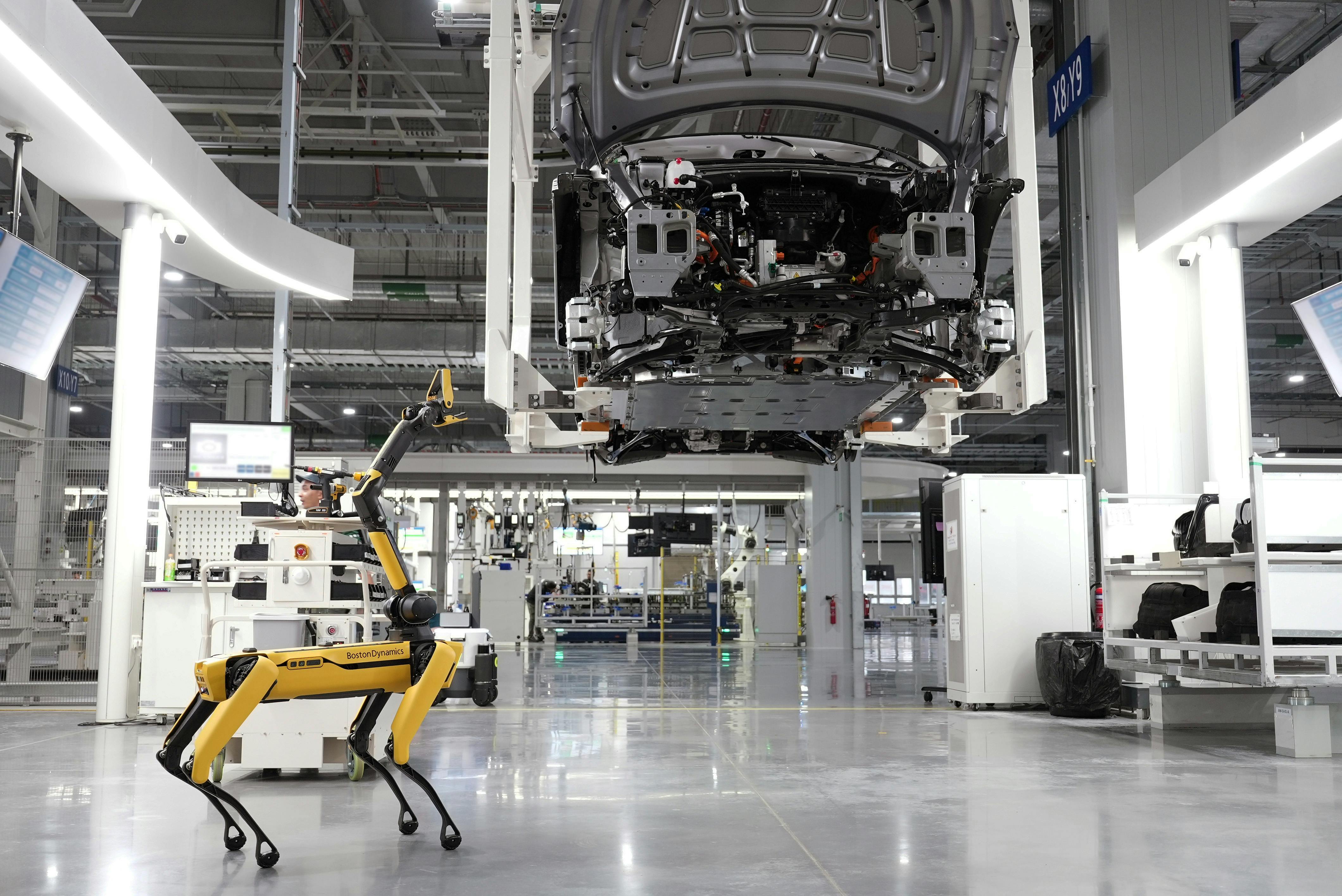
The Factory Floor Europe Forgot
There is a stretch of motorway between Wrocław and Legnica in Lower Silesia where the new Poland announces itself without subtlety. Every few kilometres, another logistics park appears behind the tree line — flat-roofed warehouses of corrugated steel and concrete panel, each one the size of several football pitches, surrounded by loading bays where articulated lorries queue in neat rows. Between the logistics parks, the factories: a Mercedes engine plant, a Whirlpool appliance facility, a Cadbury chocolate factory, a 3M adhesives plant, a Dong Yang Electronics operation producing components for LG. Drive further south towards the Czech border and the landscape thickens with manufacturing: Volkswagen engines in Polkowice, Toyota diesel engines in Jelcz-Laskowice, Amazon fulfilment centres scattered across the region like punctuation marks in a sentence that reads: this is where things are made now.
Poland is not supposed to be an industrial story. In the dominant Western European narrative, Poland is a labour market — a source of plumbers and construction workers who migrated west after EU accession in 2004, a low-cost economy useful for outsourcing call centres and IT support, perhaps a political problem on rule-of-law questions. The idea that Poland might be quietly assembling one of the most formidable manufacturing bases in Europe does not fit the established script. But the data does not care about the script.
In 2023, Poland's manufacturing sector contributed approximately 20 per cent of GDP — higher than Germany's 18.4 per cent, higher than France's 10 per cent, and more than double the United Kingdom's 9 per cent. Polish industrial production grew by 78 per cent between 2004 and 2023 in real terms. The country now produces more passenger vehicles than Italy, more household appliances than any other European country, and has become the largest furniture manufacturer in Europe and the second largest in the world after China. These are not rounding errors in the European industrial statistics. This is a structural reordering of where things are made on the continent, and it has been happening in plain sight for two decades while Western Europe was looking elsewhere.
The scale of the transformation is visible in the trade data. Poland's merchandise exports grew from approximately €47 billion in 2004 to over €310 billion in 2023 — a sixfold increase in nominal terms that turned Poland into the eighth-largest exporting economy in the European Union. Germany alone absorbs approximately 28 per cent of Polish exports. The trade relationship between the two countries has become one of the defining economic arteries of the continent, with Polish factories functioning as an integrated extension of German supply chains — a dynamic that is rewriting the economic geography of Central Europe as surely as the construction of the A2 motorway rewrote its physical geography.
How Thirty Years Built an Industrial Base
The foundations of Poland's industrial ascent were laid in the economic shock therapy of the early 1990s — a period of wrenching transformation that privatised state enterprises, opened markets to foreign competition, and created the conditions for foreign direct investment at a scale that would have been inconceivable under the previous system. The Balcerowicz Plan of 1990, named after Finance Minister Leszek Balcerowicz, was brutal in its speed and scope: price liberalisation, trade liberalisation, fiscal austerity, and rapid privatisation of state-owned enterprises. GDP contracted by more than 11 per cent in two years. Unemployment soared. Entire industrial cities that had been built around single state enterprises — shipyards in Gdańsk, steelworks in Nowa Huta, textile mills in Łódź — went through convulsions of closures and layoffs that reshaped Polish society.
But the shock therapy achieved something that gentler transitions in other post-communist economies did not: it created a market economy with genuine competition, transparent property rights, and a regulatory framework that foreign investors could understand and trust. By the mid-1990s, foreign direct investment was flowing into Poland at rates that dwarfed other Central European economies. Fiat acquired the FSM car plant in Bielsko-Biała. France's Thomson took over the Polkolor television factory. Numerous small and medium-sized German Mittelstand companies established production facilities in western Poland, drawn by the combination of low labour costs, geographic proximity, and a workforce that was technically skilled from the communist-era emphasis on vocational training.
The second wave came with EU accession in 2004. EU membership gave Poland access to the single market — 450 million consumers reachable without customs barriers — and to structural and cohesion funds at a scale that dwarfed anything available to previous accession countries. Between 2007 and 2020, Poland received over €150 billion in EU funds. For the 2021-2027 period, the allocation is approximately €76 billion. These are not aid payments in the conventional sense. They are investment capital, directed overwhelmingly towards transport infrastructure, digital connectivity, energy systems, and industrial development.
The infrastructure transformation tells the story most clearly. In 2004, Poland had approximately 500 kilometres of motorway. By 2024, it had over 4,800 kilometres of motorway and expressway. The A2 connects Berlin to Warsaw in four hours. The A4 runs from the German border through Wrocław, Katowice, and Kraków to Ukraine. Each corridor has become an axis of industrial development, with manufacturing clusters forming along the route like beads on a string.
The Special Economic Zones — and What Replaced Them
Poland's approach to attracting industrial investment has been more sophisticated than simple tax competition, though tax incentives have played an important role. The original Special Economic Zones — fourteen of them, established between 1995 and 1997 — offered corporate income tax exemptions of up to 100 per cent for investments meeting employment and capital expenditure thresholds. The zones were geographically defined, initially concentrated in regions with the highest unemployment and the weakest economic prospects. They were controversial: critics argued that they merely relocated investment that would have happened anyway, that they created enclaves of foreign-owned production with limited linkages to the domestic economy, and that the tax revenue forgone exceeded the economic benefits generated. The criticisms were partially valid, but they missed the broader effect. The zones created demonstration projects. They showed foreign investors that manufacturing in Poland could work — that the workforce was reliable, that the infrastructure was adequate, that the regulatory environment was navigable. Each successful investment reduced the perceived risk for the next one.
In 2018, Poland replaced the geographically limited zones with the Polish Investment Zone — a nationwide programme that extends tax incentives to qualifying investments anywhere in the country, with support intensity calibrated to regional development needs: up to 50 per cent of eligible costs in the less developed east, 25 per cent in the more prosperous west.
The results are measurable. The original zones attracted over 3,200 investment permits and approximately €36 billion in committed capital expenditure, directly creating over 430,000 permanent jobs. But the raw numbers understate the qualitative shift. The early investments were overwhelmingly in labour-intensive assembly — electronics, garments, basic automotive components. The recent investments are in automated production lines, R&D centres, and advanced manufacturing that requires skilled engineers rather than assembly line workers.
Poland's industrial strategy did not pick winners. It built infrastructure, created incentive frameworks, invested in workforce skills, and let the market decide what to manufacture. The market decided to manufacture nearly everything.
Editorial analysis
The Automotive Corridor
Nowhere is Poland's industrial transformation more visible than in the automotive sector. Poland does not have a national car brand — no Volkswagen, no Renault, no Fiat of its own. What it has is something arguably more valuable in the modern automotive supply chain: a deep, diversified manufacturing ecosystem that produces components, subassemblies, and finished vehicles for virtually every major European automaker. Poland is now the second-largest automotive manufacturer in Central and Eastern Europe after the Czech Republic, and when measured by the breadth of its supplier base rather than finished vehicle output alone, it may already be the largest.
The numbers are instructive. In 2023, Poland produced approximately 530,000 passenger vehicles — primarily at Stellantis plants in Tychy and Gliwice (formerly Fiat and Opel), with additional production at Volkswagen's Poznań plant (commercial vehicles) and Toyota's Wałbrzych and Jelcz-Laskowice operations (engines and transmissions). But finished vehicle assembly represents only the visible tip of a much larger industrial iceberg. Poland has over 900 automotive parts manufacturers, employing approximately 210,000 workers. These range from global tier-one suppliers — ZF Friedrichshafen, Continental, Bosch, Denso, Valeo — to Polish-owned companies that have built competitive positions in specialised niches. The country produces approximately 40 per cent of Europe's automotive wiring harnesses, a labour-intensive but technically demanding component category that is critical to vehicle electrical architecture.
The electric vehicle transition is accelerating this pattern rather than disrupting it. Battery manufacturing is emerging as a major new pillar of Polish industry. LG Energy Solution operates a large-format battery cell plant in Wrocław — one of the largest EV battery factories in Europe — that supplies cells for Volkswagen, Renault, and other European automakers. SK Innovation (now SK On) invested €2.3 billion in a battery plant in Komárom, just across the Hungarian border, but has also established operations in Poland. Umicore, the Belgian materials technology company, opened a cathode materials plant in Nysa in southern Poland to supply the growing battery manufacturing cluster. The emerging geography of European EV battery production places Poland at its centre — a position that will become more strategically significant as the EU's battery regulation tightens local content and supply chain due diligence requirements.
The automotive sector illustrates a broader pattern in Poland's industrial development: the country has positioned itself not as a competitor to Western European industry but as its essential complement. When a German automaker needs to reduce costs without leaving the EU single market, Poland is the answer. When a Japanese component manufacturer needs a European production base, Poland is the answer. When a Korean battery maker needs to localise production to meet EU rules of origin requirements, Poland is the answer. This complementarity is Poland's greatest industrial strength and, potentially, its greatest vulnerability — a question we will return to.
The furniture industry tells a parallel story that receives less attention but is equally revealing. Poland is the largest furniture manufacturer in Europe and the second largest in the world, behind only China. The industry employs approximately 160,000 workers and generates annual exports exceeding €13 billion. Companies like Nowy Styl, the office furniture manufacturer based in Krosno in southeastern Poland, and Forte, which produces flat-pack furniture from facilities in Ostrów Mazowiecka and Suwałki, have grown from post-communist workshop operations into companies that compete directly with Scandinavian and German manufacturers on quality while maintaining a cost advantage. The furniture cluster stretches from the Wielkopolska region — historically Poland's woodworking heartland — across the east and south, drawing on Poland's substantial forestry resources (forests cover approximately 30 per cent of the country's territory) and a tradition of woodworking that predates industrialisation. IKEA sources more products from Poland than from any other country in the world — a single data point that captures the scale of what has been built.
The Workforce Advantage — and Its Limits
Poland's industrial growth has been underpinned by a workforce advantage that is more nuanced than the simple "cheap labour" narrative suggests. Yes, labour costs are lower than in Western Europe — average manufacturing wages in Poland in 2023 were approximately €13 per hour, compared with €42 in Germany, €39 in France, and €30 in Italy. But the cost differential alone does not explain why Poland has attracted manufacturing investment that could have gone to Romania (average manufacturing wages: €9 per hour), Bulgaria (€7), or Turkey (€5). The answer lies in a combination of labour productivity, workforce quality, and demographic scale that Poland offers and most of its regional competitors do not.
Polish labour productivity in manufacturing has grown by over 160 per cent since 2000, one of the fastest sustained productivity gains of any major European economy. When adjusted for purchasing power, Polish unit labour costs in manufacturing are approximately 50 per cent of the German level — but productivity per worker is approximately 65 per cent of the German level and rising. The gap between cost and productivity is the margin that makes Polish manufacturing competitive: employers pay significantly less than in Western Europe but receive workers whose output per hour is closer to Western European levels than the wage differential would suggest. This is not a stable equilibrium — wages are rising faster than in Western Europe, and the cost advantage is narrowing — but the convergence has decades of runway before Poland reaches cost parity with Germany or France.
The education pipeline is a critical but underappreciated factor. Poland's educational system, reformed significantly since the 1990s, produces approximately 80,000 engineering and technical graduates per year — a number that reflects both the size of Poland's university sector (nearly 400 higher education institutions) and a cultural emphasis on technical and engineering education that predates EU accession. Polish fifteen-year-olds consistently score above the OECD average in mathematics and science on PISA assessments — ahead of France, the United States, and the United Kingdom. The practical effect is a workforce that can operate and maintain advanced manufacturing equipment, adapt to new production technologies, and contribute to the continuous improvement processes that modern manufacturing demands.
But the workforce advantage has limits that are becoming visible. Poland's unemployment rate fell to 2.8 per cent in late 2023 — effectively full employment. Labour shortages are now the most frequently cited constraint on industrial expansion, particularly in western Poland where the concentration of manufacturing facilities has created intense competition for workers. Companies in the Wrocław region report that recruiting skilled production workers now requires offering wages that are 15-20 per cent above the regional average, plus benefits packages that were unheard of a decade ago: private healthcare, subsidised housing, company transport, and retention bonuses. The tight labour market is pulling wages upward at 8-10 per cent annually in the manufacturing sector — a rate that, if sustained, will erode the cost advantage that attracted foreign investment in the first place.
Poland's response has been immigration — specifically, the large-scale absorption of Ukrainian workers that began before Russia's full-scale invasion in February 2022 and accelerated dramatically after it. By 2024, an estimated 1.5 to 2 million Ukrainians were working in Poland, many of them in manufacturing, logistics, and construction. This immigration has been essential to maintaining the labour supply that Poland's industrial growth requires. It has also introduced new social and political dynamics in a country that was, until recently, one of the most ethnically homogeneous in Europe. The integration of Ukrainian workers has been remarkably smooth by European standards — facilitated by linguistic proximity, cultural familiarity, and the sheer demand for labour — but the long-term sustainability of this labour source depends on the trajectory of the war in Ukraine and the eventual competition for returning workers when reconstruction begins.
The demographic picture adds another layer of complexity. Poland's total fertility rate has fallen to approximately 1.16 children per woman — among the lowest in Europe. The country's population is projected to decline from 37.8 million to approximately 34 million by 2050 under current trends. The industrial base is expanding at the same time as the domestic labour pool is beginning to contract — a structural tension at the heart of Poland's growth model that Ukrainian immigration is currently masking but not resolving.
The Nearshoring Moment
Poland's industrial trajectory was already strong before COVID-19 and the war in Ukraine. What those disruptions did was transform Poland from a competitive manufacturing location into a strategic one. The pandemic exposed the fragility of extended supply chains. The war added a geopolitical dimension: European companies had built dependencies on countries — Russia for energy, China for components — whose alignment with European interests could not be assumed. Nearshoring moved from corporate buzzword to corporate strategy. And Poland was the obvious beneficiary.
Its position within the EU single market eliminates trade barriers. Its geography — central enough to reach any Western European market within one to two days by truck, close enough to Germany to function as an extension of German supply chains — is optimal. Its existing industrial base meant that incoming companies did not need to build supply networks from scratch; the ecosystem was already there.
The evidence is visible in the investment pipeline. Intel announced a $4.6 billion semiconductor facility near Wrocław in 2022 — the single largest greenfield industrial investment in Polish history. While Intel paused the project amid corporate restructuring in 2024, the choice of Poland reflected the country's standing. Amazon, already Poland's largest private-sector employer with over 25,000 workers, continues to expand. Google and Microsoft have committed to data centre investments totalling several billion euros. Daikin, Nexteer, and numerous mid-sized German and Scandinavian manufacturers have announced new Polish facilities since 2022.
The nearshoring thesis is not merely about cost. It is about resilience. A production line in Poland can be visited by a German procurement director in a two-hour flight. Spare parts ship overnight by truck. Contract disputes are resolved under EU law. Environmental and labour standards are harmonised with the single market. For a manufacturer whose board has been asking about supply chain risk since 2020, Poland offers an answer that is both economically rational and politically defensible.
The defence sector adds another dimension. Poland's defence spending reached 4 per cent of GDP in 2024 — the highest in NATO as a percentage of national income. The country has signed procurement contracts worth tens of billions of euros for South Korean tanks, American missile systems, and European combat aircraft, with industrial offsets and technology transfer as conditions. Polish defence companies — PGZ, WB Group — are positioning to become suppliers to a European defence industrial base that is expanding rapidly. The Stalowa Wola steelworks, once a symbol of communist-era heavy industry, now produces self-propelled howitzers. The defence build-up channels investment into precision engineering, electronics, and advanced materials — capabilities that spill over into civilian manufacturing.
The Vulnerabilities Nobody Mentions
The optimistic reading of Poland's industrial story — and it is the reading that dominates investment promotion materials, EU institutional communications, and much of the business press — is that Poland has found a sustainable development model that will carry it to Western European income levels within a generation. This reading is not wrong, but it is incomplete. Poland's industrial base, for all its scale and diversity, carries structural vulnerabilities that the optimistic narrative tends to gloss over.
The first vulnerability is dependence. Poland's manufacturing sector is overwhelmingly foreign-owned. The strategic decisions that determine whether a factory expands, contracts, or closes are made in Stuttgart, Tokyo, Seoul, and Detroit — not in Warsaw or Wrocław. When Stellantis restructures its European production network, Tychy competes against Sochaux and Melfi for model allocation. When Volkswagen rationalises its supply chain, the Poznań facility is evaluated against alternatives in Spain and Slovakia. Poland's factories are pieces on a chessboard where the players sit elsewhere.
The second vulnerability is value capture. A Toyota engine manufactured in Jelcz-Laskowice is a Japanese product made in Poland. The manufacturing margin stays; the design margin, the brand premium, and the majority of the profit leave. This is not unique to Poland — it characterises most FDI-dependent manufacturing economies — but it means that Poland's GDP per capita growth understates the extent to which Poland is building industrial capacity for others rather than for itself.
Poland has done something remarkable: it has built a world-class industrial base in thirty years. The question it now faces is whether it can move from making things for others to owning the things it makes.
Editorial analysis
The third vulnerability is energy. Poland generates approximately 70 per cent of its electricity from coal — the highest share in the EU. Under the EU Emissions Trading System, this carries a carbon cost passed through to industrial consumers. Polish industrial electricity prices have risen sharply since 2021, narrowing the energy cost advantage. As large industrial customers increasingly require supply chain carbon footprint data, Poland's coal-intensive grid risks becoming a competitive liability. The transition to renewables is underway — Poland installed more solar capacity than any other European country in 2023 — but the legacy coal infrastructure will take decades to replace.
- Foreign ownership dominates: strategic decisions made abroad, not in Poland
- Value capture gap: manufacturing margins stay, but design, brand, and IP margins leave
- Energy transition risk: 70% coal electricity faces rising EU carbon pricing
- Labour market tightening: 2.8% unemployment driving 8-10% annual wage growth
- EU fund dependency: structural investment funded by transfers that will eventually taper
- Political risk: rule-of-law disputes with Brussels have historically threatened fund disbursements
The fourth vulnerability is EU fund dependency. Poland's infrastructure has been substantially financed by EU structural funds. As Poland's GDP per capita rises — it has already surpassed Portugal and is converging on Spain — its eligibility for cohesion funding will diminish. The 2021-2027 budget cycle may represent peak EU transfers. Future cycles will redirect funds towards newer member states and EU defence priorities. Poland will need to generate investment capital from its own economy rather than from Brussels — and whether the institutions and capital markets are mature enough to fill that gap remains an open question.
What Poland Tells Europe
Poland's industrial story is significant not because it is unique but because it demonstrates what is possible when structural conditions align. A large, educated, motivated workforce. Massive sustained capital investment in physical and digital infrastructure. Geographic centrality within the European trade zone. Tax and regulatory incentive frameworks that are competitive without being predatory. Political stability sufficient to give long-term investors confidence. These are not mysterious ingredients. They are the basic requirements for industrial development, and Poland has assembled them more effectively than any other European economy in the post-Cold War period.
The lesson for Europe is not that other countries should replicate Poland's model — each country's starting conditions, demographics, geography, and political economy are different. The lesson is that industrial development is not an accident, and deindustrialisation is not inevitable. Poland did not inherit its manufacturing base. It built it, deliberately, over thirty years, through a combination of policy choices, infrastructure investment, educational priorities, and strategic positioning within the European economic architecture. The factories that line the A4 motorway are the physical evidence of decisions made in Warsaw, Brussels, and corporate boardrooms across Europe — decisions that redirected capital, built roads, trained engineers, and created the conditions under which private investment chose Poland over alternatives.
Western Europe looks at its own deindustrialisation and tends to attribute it to forces beyond its control: globalisation, Chinese competition, labour costs, environmental regulation. Poland's experience suggests a different framing. Western Europe did not lose its industry to inevitable forces. It made choices — about energy costs, about regulatory burden, about infrastructure investment, about education and training priorities — that made manufacturing progressively less attractive compared with alternatives. Poland made different choices and got different results. Both sets of choices had costs. The question facing Europe now is which costs it is willing to bear, and which consequences it is prepared to live with.
There is a deeper question that European policymakers have been reluctant to confront: what happens when the convergence is complete? Poland's model works because the gap exists — the gap in wages, in costs, in infrastructure. As that gap narrows, Poland will face the same pressures that currently afflict Western European manufacturers. The Czech Republic, which industrialised faster in the 1990s, is already experiencing this compression — its labour costs have risen to levels where some manufacturers are shifting production further east. Poland is perhaps fifteen years behind on this trajectory. The question is not whether the compression will come, but what Poland will have built by the time it arrives.
In the A2 corridor between Berlin and Warsaw, the answer is already being written in concrete, steel, and silicon. The trucks carry finished goods west and raw materials east. The factories hum around the clock, three shifts, six days a week. The engineers — Polish, Ukrainian, German, Indian — write production reports in English and argue about quality specifications in Polish. The EU structural funds are building the next section of motorway. And the procurement directors in Munich and Stuttgart, when they need a new supplier who can deliver on time, within the single market, at a competitive price, with a workforce that turns up and a government that does not change the rules mid-contract — they open their laptops and look at a map. Poland is right there in the centre. It always was. Europe is only now beginning to notice.
Sources
- Eurostat — Manufacturing as percentage of GDP by country — https://ec.europa.eu/eurostat/databrowser/view/nama_10_a64/default/table
- European Commission — Cohesion Policy allocations for Poland 2021-2027 — https://cohesiondata.ec.europa.eu/countries/PL
- PAIH — Polish Investment and Trade Agency: Automotive Sector Overview — https://www.paih.gov.pl/en/sectors/automotive
- GUS — Statistics Poland: Industrial Production Index — https://stat.gov.pl/en/topics/industry-construction-fixed-assets/
- OECD — PISA 2022 Results: Poland Country Note — https://www.oecd.org/pisa/
- NBP — National Bank of Poland: Foreign Direct Investment Statistics — https://www.nbp.pl/en/statystyka/dwn/bop_q_e.xlsx
- European Commission — European Chips Act: Intel investment in Poland — https://ec.europa.eu/commission/presscorner/detail/en/ip_22_729
- IEA — Poland Energy Policy Review 2022 — https://www.iea.org/reports/poland-2022