Taranto's steel problem is Europe's industrial mirror
What one steel plant reveals about the contradictions of European industrial policy
By VastBlue Editorial · 2026-03-26 · 18 min read
Series: Reindustrialising Europe · Episode 1
The Plant That Cannot Die
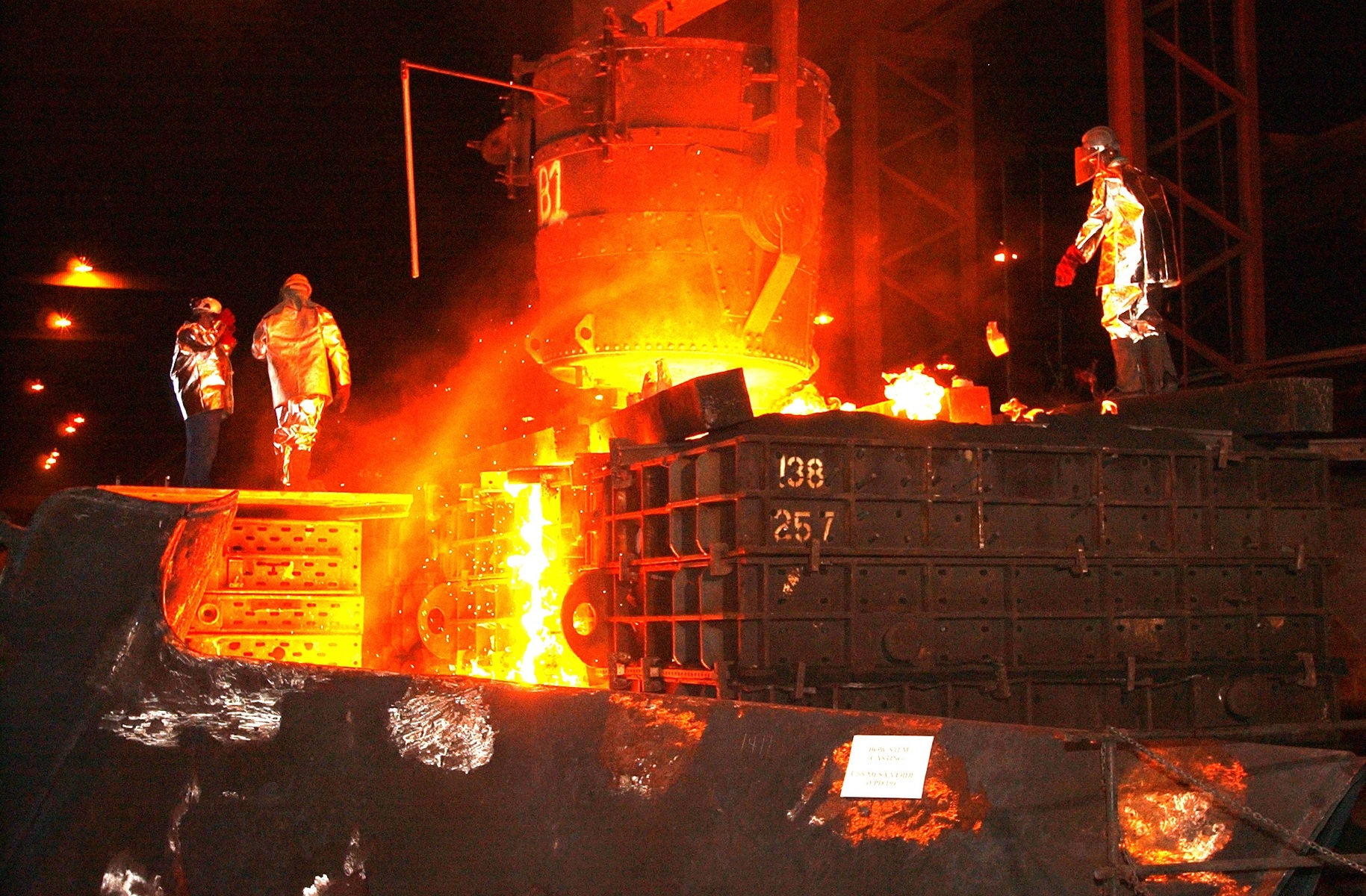
Drive south from Bari along the SS100 and the landscape flattens into the coastal plain of Puglia — olive groves, limestone soil, the long horizontal light of southern Italy. Then, before Taranto announces itself as a city, the steelworks appear. They appear the way a mountain range appears: gradually, then all at once. Blast furnaces rising eighty metres into the sky. Coke ovens stretching in rows like the vertebrae of some enormous fossil. Sinter plants, hot strip mills, cold rolling lines, a captive power station, its own port facilities, its own railway network. The Ilva steelworks covers fifteen square kilometres — roughly the same area as the old city of Taranto itself. It is the largest integrated steel plant in Western Europe. At peak capacity, it produced over ten million tonnes of crude steel per year, roughly forty per cent of Italy's entire output. It employed over eleven thousand workers directly and supported an estimated forty thousand jobs in the surrounding region through its supply chain.
It is also one of the most contaminated industrial sites on the European continent.
These two facts — economic centrality and environmental devastation — have coexisted in Taranto for over sixty years. They are not in tension. They are the same fact, viewed from different angles. The plant feeds the city and poisons it simultaneously. Every tonne of steel that rolls off the hot strip mill represents both economic survival and environmental degradation. Every job preserved is a body exposed to emissions that epidemiological studies have linked to elevated rates of cancer, respiratory disease, and infant mortality. This is not a metaphor. This is the daily arithmetic of a city that has been performing an impossible calculation since 1965.
The Ilva story is often presented as an Italian problem — a product of southern Italian patronage networks, of Roman bureaucratic dysfunction, of the particular Italian talent for allowing crises to mature slowly while everyone watches. This framing is comforting and wrong. Taranto is not an Italian anomaly. It is the sharpest expression of a contradiction that runs through the entire European industrial landscape: the simultaneous commitment to maintaining industrial employment, achieving environmental compliance, and remaining competitive against producers who face neither constraint. These three objectives are not difficult to reconcile. They are, under current conditions, mathematically incompatible. Taranto simply arrived at this impossibility first, and has been living inside it longer than anyone else.
A History Written in Emissions
The plant was built by the Italian state. IRI — the Istituto per la Ricostruzione Industriale, the great holding company that managed Italy's post-war industrial reconstruction — broke ground on the Taranto site in 1960 and began production in 1965. The logic was straightforward developmental economics: Italy needed steel for its economic miracle, the south needed industrialisation to close the gap with the north, and Taranto's deep-water harbour made it a natural site for an integrated coastal steelworks that could receive iron ore by ship and export finished product by rail and sea. IRI poured the equivalent of billions of euros into the facility over the following decades, expanding capacity repeatedly through the 1970s and 1980s until Taranto was producing steel at a scale that rivalled the largest plants in Germany and Japan.
The environmental consequences were apparent almost from the beginning, but in the calculus of 1960s industrial development, they were treated as externalities — costs borne by someone else, somewhere else, later. The coke ovens released benzene, polycyclic aromatic hydrocarbons, and volatile organic compounds into the air. The sinter plant — where iron ore fines are agglomerated into a feedstock suitable for the blast furnace — emitted dioxins and furans at levels that would later be measured among the highest of any industrial facility in Europe. Particulate matter settled on the surrounding neighbourhood of Tamburi, literally dusting the streets and houses with a fine red-brown mineral residue that residents called "il minerale." Children played in playgrounds coated with it. Laundry hung out to dry came back inside with a metallic sheen. The wind carried emissions across the city depending on the prevailing direction — northwest winds pushed the plume over the residential areas closest to the plant; southeast winds carried it over the Mar Piccolo, the enclosed lagoon that had historically supported Taranto's mussel farming industry.
The mussel farms of the Mar Piccolo — once among the most productive shellfish cultivation sites in the Mediterranean — were contaminated by heavy metals and dioxins leaching from the industrial site into the enclosed lagoon. Taranto's mussels had been a source of local identity and economic activity for centuries. By the early 2000s, periodic harvesting bans had become routine, and the industry that had predated the steelworks by generations was being slowly strangled by the effluent of the industry that was supposed to bring prosperity. The irony was not lost on anyone in Taranto, but irony does not pay mortgages.
The Riva family entered the picture in 1995. Emilio Riva, the patriarch of Italy's largest private steel dynasty, purchased the plant from IRI as part of the privatisation wave that swept through Italian state industry in the 1990s. The privatisation was politically expedient — the Italian state was under pressure from the European Commission to reduce state aid to industry, and IRI itself was being dismantled. Riva Group paid approximately 1.6 billion euros for the Taranto works, a price that reflected both the plant's enormous productive capacity and the enormous environmental liabilities that came with it. Whether the Riva family fully appreciated the scale of those liabilities at the time of purchase is a question that subsequent legal proceedings would explore at considerable length.
Under Riva management, the plant continued to operate at high capacity. Production remained above eight million tonnes per year for most of the period between 1995 and 2012. Employment held relatively stable. The environmental situation did not improve. In 2005, the European Commission's IPPC — Integrated Pollution Prevention and Control — Directive established Best Available Technique reference documents for the iron and steel sector, setting emission benchmarks that modern facilities were expected to meet. Taranto's actual emissions exceeded these benchmarks by factors that were, in some categories, measured in orders of magnitude. The gap between what the plant emitted and what European environmental law expected it to emit was not a technical nuance. It was a chasm.
In July 2012, the judiciary of Taranto issued a seizure order against the plant's hot area — the blast furnaces, coke ovens, and sinter plant — on the grounds that the facility's emissions constituted a continuing danger to public health. Judge Patrizia Todisco's order, based on technical assessments and epidemiological data, effectively shut down the core of the steelworks. The legal reasoning was devastating: the plant's operations were not merely in violation of environmental regulations. They were, in the court's assessment, causing measurable harm to the health and lives of Taranto's residents. The Riva family's leadership was placed under criminal investigation for environmental disaster and failure to implement required pollution controls. Emilio Riva's son, Fabio Riva, fled to London to avoid arrest.
The Impossible Decree
What happened next revealed something fundamental about the relationship between law, politics, and industrial reality in Europe. The Italian government — first under Mario Monti, then under Enrico Letta and subsequently Matteo Renzi — intervened with a series of extraordinary legislative decrees that overrode the judicial seizure order and allowed the plant to continue operating. The legal mechanism was unprecedented: the government declared Ilva a "strategic national interest" and passed legislation that explicitly permitted continued production while environmental remediation was supposedly underway. In effect, the Italian parliament passed a law that said: this plant is too important to close, even if a court has determined that it is killing people.
The Italian Constitutional Court upheld the decree, ruling that the right to health and the right to work were both constitutionally protected and that the legislature had the authority to balance them — even when balancing meant permitting ongoing environmental harm for an undefined transitional period.
Italian Constitutional Court, Judgment No. 85/2013
This was not a uniquely Italian decision. It was the logical outcome of a set of constraints that exist across Europe. Close the plant and eleven thousand workers lose their jobs immediately. Forty thousand more lose theirs within months as the supply chain collapses. A city that already has one of the highest unemployment rates in Italy loses its largest employer. The social cost is calculable and immediate. Keep the plant open and the environmental harm continues, but the harm is statistical — it shows up in cancer registries and mortality tables five, ten, twenty years later, distributed across a population rather than concentrated in identifiable individuals. Politicians who close the plant face immediate, visible, politically devastating consequences. Politicians who keep it open face consequences that are diffuse, delayed, and attributable to multiple factors. The political calculus is ugly, but it is not irrational.
The decree required the plant's operator to implement an environmental remediation plan — the Piano Ambientale — within specified timelines. The plan was technically ambitious: covering the coal and mineral storage parks to prevent wind-dispersed particulate emissions, installing new filtration systems on the sinter plant and coke ovens, upgrading wastewater treatment, remediating contaminated soil and groundwater across the site. The estimated cost of full compliance was in the billions. The timeline stretched to 2023, later extended to 2026, with interim milestones that were repeatedly missed, revised, and renegotiated. The pattern was familiar to anyone who has studied industrial environmental compliance in Europe: ambitious targets, flexible deadlines, incremental progress, and a persistent gap between what the law requires and what the facility actually does.
ArcelorMittal: The Private Capital Experiment
In 2018, ArcelorMittal — the world's largest steelmaker, headquartered in Luxembourg, controlled by the Mittal family — won the competitive tender to acquire Ilva's operations. The deal, structured as a lease with an option to purchase, valued the business at approximately 1.8 billion euros and included commitments to invest 2.4 billion in environmental remediation and plant modernisation, maintain employment at approximately ten thousand workers, and increase production back toward eight million tonnes per year. ArcelorMittal was, on paper, the ideal partner: a global operator with deep technical expertise, access to capital markets, and experience running integrated steelworks across multiple regulatory jurisdictions. If anyone could fix Taranto, the logic went, it was the company that operated steel plants from Dunkirk to Burns Harbor, from Gent to Temirtau.
The marriage lasted less than two years before it began to unravel. In November 2019, ArcelorMittal announced its intention to withdraw from the Ilva acquisition, citing the Italian government's decision to revoke a legal shield that had protected the plant's operators from criminal liability for environmental contamination occurring during the remediation period. The legal shield — known as the "scudo penale" — had been a central condition of ArcelorMittal's bid. Its removal, the company argued, fundamentally changed the risk profile of the investment. Without legal protection during the transition period, ArcelorMittal's management could face personal criminal prosecution for environmental damage that predated their involvement — damage caused by decades of operation under previous owners.
The Italian government characterised ArcelorMittal's withdrawal as a breach of contract and initiated legal proceedings. ArcelorMittal countered that the government had altered the terms of the agreement after the fact. Behind the legal arguments, a more fundamental issue was at work: ArcelorMittal had looked at the full cost of bringing Taranto into environmental compliance while maintaining commercially viable production levels, and the numbers did not add up. The investment required exceeded what the plant could plausibly return, particularly in a European steel market that was already struggling with overcapacity, rising energy costs, and increasing carbon pricing under the EU Emissions Trading System.
After months of negotiation, a compromise was reached. In 2021, the Italian government took a direct equity stake in the Taranto operations through Invitalia, the national agency for inward investment. The resulting joint venture — Acciaierie d'Italia, later rebranded — gave the state a minority stake with the option to increase to majority control. ArcelorMittal remained as operator but with reduced financial exposure. The structure was a hybrid that satisfied nobody: not the workers, who saw employment commitments being steadily revised downward; not the environmentalists, who saw remediation timelines being extended again; not the taxpayers, who were now directly financing a loss-making industrial operation; and not ArcelorMittal, which was operationally committed to a plant it clearly wanted to leave.
The Numbers That Define the Trap
To understand why Taranto resists resolution, you need to understand the economics of integrated steelmaking in twenty-first-century Europe. An integrated steel plant — one that starts with iron ore and coal and produces finished steel products through the blast furnace–basic oxygen furnace route — is one of the most capital-intensive, energy-intensive, and carbon-intensive industrial operations in existence. The blast furnace itself operates at temperatures exceeding 2,000°C, fuelled primarily by metallurgical coke derived from coal. The chemical reaction at the heart of the process — the reduction of iron oxide to metallic iron using carbon monoxide — is not merely energy-intensive. It is, by its fundamental chemistry, a carbon-emitting process. For every tonne of steel produced via the blast furnace route, approximately 1.8 to 2.0 tonnes of CO₂ are emitted.
The European steel industry produces approximately 150 million tonnes of crude steel per year, roughly half via the blast furnace route and half via the electric arc furnace route, which melts recycled scrap rather than reducing virgin ore. The blast furnace route is necessary because Europe's steel demand exceeds its supply of available scrap — you cannot run a circular economy in a sector where demand is still growing. This means that roughly 75 million tonnes of European steel production is tied to the blast furnace route and its associated carbon emissions. Under the EU Emissions Trading System, these emissions carry a direct cost. At a carbon price of 65 euros per tonne of CO₂ — roughly the ETS price as of early 2026 — the carbon cost alone adds approximately 120 euros to every tonne of blast furnace steel. For a plant producing five million tonnes per year, that is 600 million euros annually in carbon costs alone, before labour, raw materials, energy, maintenance, or debt service.
China produces over one billion tonnes of steel per year — more than half the global total — in facilities that face no equivalent carbon pricing, lower labour costs, lower energy costs, and less stringent environmental regulation. Turkish steelmakers, operating just across the Mediterranean from Taranto, benefit from lower energy costs and a regulatory environment that, while improving, does not yet impose the same environmental costs as the EU framework. Indian steel production is expanding rapidly under similarly favourable cost conditions. The result is a structural competitive disadvantage for European integrated steelmakers that carbon border adjustment mechanisms — the EU's CBAM, scheduled for full implementation by 2026 — are designed to offset but have not yet proven capable of fully addressing.
For Taranto specifically, the arithmetic is even more punishing. The plant requires approximately four to five billion euros in investment to achieve full environmental compliance and modernise its production facilities to current technical standards. Its annual revenue, at current production levels of approximately four million tonnes — well below its design capacity of ten million — is in the range of three to four billion euros, with operating margins that have been negative in recent years. The investment required to fix the plant exceeds the plant's current market capitalisation, its annual revenue, and any plausible return on investment over a reasonable time horizon. In simple terms: it costs more to fix the plant than the plant is worth.
- Full environmental remediation: €4-5 billion estimated
- Annual carbon cost at current ETS prices: €400-600 million
- Current annual production: ~4 million tonnes (vs 10 million design capacity)
- Direct employment: ~8,200 (down from 11,500 in 2012)
- Indirect employment at risk: estimated 30,000-40,000 regional jobs
- Operating margins: negative in 2023 and 2024
- Italian government equity committed: over €1 billion since 2021
The Green Steel Mirage
The proposed solution — the solution that appears in every policy document, every ministerial statement, every EU industrial strategy communication — is green steel. Replace the blast furnaces with electric arc furnaces powered by renewable energy, or with hydrogen-based direct reduction plants that use green hydrogen instead of coal as the reducing agent. Eliminate the carbon from the chemistry entirely. Transform Taranto from a symbol of industrial pollution into a showcase of industrial decarbonisation. The narrative is appealing. The engineering is real. And the timeline is, at best, optimistic.
Hydrogen-based direct reduction — the H2-DRI route — is the technology most frequently cited as the future of primary steelmaking. Instead of using carbon monoxide from coke to strip oxygen from iron ore, H2-DRI uses hydrogen gas. The byproduct is water rather than CO₂. The Swedish consortium HYBRIT, backed by SSAB, LKAB, and Vattenfall, has demonstrated the technology at pilot scale in Luleå, producing the world's first fossil-free steel in 2021. Salzgitter in Germany and Thyssenkrupp are pursuing their own hydrogen steel projects. ArcelorMittal itself has announced a 1.7-billion-euro investment in its Gent facility in Belgium to build a DRI plant paired with an electric arc furnace. The technology works. The question is not whether hydrogen steel is possible. The question is whether it is possible at Taranto, at the scale required, within the timeline that the city's residents and workers need.
The answer involves three constraints that policy documents tend to gloss over. First, hydrogen-based steelmaking requires enormous quantities of green hydrogen — hydrogen produced by electrolysis powered by renewable energy. A five-million-tonne steel plant operating on the H2-DRI route would require approximately 500,000 tonnes of green hydrogen per year. Current global production of green hydrogen is approximately 100,000 tonnes per year. The electrolyser capacity required, and the renewable electricity generation to power it, would need to be built essentially from scratch in a region — southern Italy — that has abundant solar resources but limited grid infrastructure, water constraints, and a permitting environment that has historically delayed large infrastructure projects by years.
Second, the capital cost of a greenfield H2-DRI plant at the scale needed for Taranto would be in the range of five to seven billion euros — replacement capital expenditure on top of the remediation costs for the existing site, which would still need to be cleaned up even if the blast furnaces were permanently shut down. The contaminated soil does not decontaminate itself when you turn off the furnaces. Third, the transition timeline. Even under optimistic assumptions — financing secured, permits granted, construction proceeding without delays — a new H2-DRI plant at Taranto could not begin production before 2032 at the earliest. HYBRIT's own timeline for commercial-scale production in Sweden, operating in a regulatory environment far more favourable to industrial permitting than Italy's, is 2026 for demonstration scale and 2030 for full commercial production. Taranto would need to continue operating its existing blast furnaces throughout the transition period, maintaining employment and production while simultaneously building a replacement facility on the same fifteen-square-kilometre footprint.
Green steel is not a solution to Taranto's problem. It is a second problem layered on top of the first. The city must survive the transition to reach the destination, and the transition itself may take a decade that neither the workers nor the environment can afford.
Editorial analysis
What Taranto Teaches Europe
Taranto is not a special case. It is a preview. Across Europe, heavy industrial facilities are approaching the same inflection point: the moment when the combined cost of environmental compliance, carbon pricing, and competitive pressure from non-EU producers exceeds the economic value of continued operation. The question is not whether this moment will arrive for other plants. It is when, and whether the political systems of the countries that host them will respond with more honesty and less improvisation than Italy has managed in Taranto.
Germany's Thyssenkrupp Duisburg complex — the largest single-site steel facility in Europe — faces an analogous set of constraints: massive remediation costs, rising carbon prices, competitive pressure from imports, a workforce that numbers in the tens of thousands, and a political context in which closure is not considered a permissible option. The Thyssenkrupp board has committed to a hydrogen transition, but the financing remains uncertain and the timeline extends into the 2030s. In the meantime, the blast furnaces continue to operate under the existing emissions profile. The pattern is the same: commit to transformation, extend the timeline, keep the status quo running while waiting for the future to arrive.
Port Talbot in Wales. Dunkirk in northern France. Košice in eastern Slovakia. Galați in Romania. Each hosts a major integrated steelworks. Each faces some version of the Taranto equation: the cost of staying exceeds the plant's economic return; the cost of leaving — in jobs, in supply chain disruption, in strategic industrial capacity — is politically unacceptable; and the cost of transforming to green steel is, for now, somewhere between difficult and impossible to finance. The EU's Carbon Border Adjustment Mechanism is intended to level the playing field by imposing carbon costs on imported steel equivalent to what European producers pay under the ETS. But CBAM applies only to direct imports into the EU — it does not prevent carbon leakage through intermediate products manufactured outside Europe from cheap steel and then imported as finished goods.
The deeper lesson of Taranto is about the nature of industrial transitions themselves. Europe's political discourse treats industrial transformation as a planning problem — as if the right combination of subsidies, regulations, and timelines can smooth the path from old industry to new industry without anyone getting hurt. Taranto demonstrates that this is a fantasy. Industrial transitions are violent. They destroy wealth, displace workers, contaminate communities, and create political crises that persist for decades. The question is not how to avoid the violence but how to distribute it — who bears the cost, over what timeline, with what compensation, and with what democratic legitimacy.
Italy has spent over a decade trying to answer this question for a single steel plant and has not yet succeeded. The workers of Taranto have endured years of uncertainty — rolling layoffs, cassa integrazione payments that replace a fraction of normal wages, the grinding anxiety of not knowing whether their plant will be open next year. The residents of Tamburi have endured years of ongoing exposure to emissions that independent health studies continue to document as harmful. The Italian taxpayer has committed billions in direct and indirect subsidies to an operation that has not generated a positive return in years. And the steel — the actual physical product — continues to be produced at volumes well below what the plant was designed for, at costs well above what the market will bear without subsidies, in a facility that remains years away from environmental compliance.
The reindustrialisation of Europe — the phrase that policy documents deploy with increasing frequency — will require confronting the Taranto problem not once but dozens of times, across dozens of facilities, in dozens of communities, in multiple member states with different political cultures, different labour markets, and different fiscal capacities. Each transition will involve the same impossible arithmetic: jobs versus environment, private capital versus public subsidy, short-term survival versus long-term transformation. Each will tempt political leaders to reach for the same tools that Italy has used — extraordinary legislation, extended timelines, creative accounting, and the quiet hope that technology will solve the problem before politics has to.
Taranto suggests that hope is not a strategy. The plant still stands. The furnaces still burn, at reduced capacity, under state control, losing money, polluting less than before but more than the law allows, employing fewer workers than promised but more than any alternative can replace. It is a monument to the gap between Europe's industrial ambitions and Europe's industrial reality. It is also, if we are honest about what it teaches, the most important industrial site on the continent — not for what it produces, but for what it reveals about what European reindustrialisation will actually cost, and who will actually pay for it.
Sources
- Italian Constitutional Court, Judgment No. 85/2013 — https://www.cortecostituzionale.it/actionSchedaPronuncia.do?anno=2013&numero=85
- ISPRA Technical Report on Taranto Emissions — https://www.isprambiente.gov.it/it/pubblicazioni/rapporti
- European Commission BREF for Iron and Steel Production — https://eippcb.jrc.ec.europa.eu/reference/iron-and-steel-production
- HYBRIT — Fossil-free Steel Technology — https://www.hybritdevelopment.se/
- Eurofer — European Steel in Figures 2025 — https://www.eurofer.eu/publications/archive/european-steel-in-figures/
- Ferrante et al., "Health Effects of Residence Near the Ilva Steelworks," International Journal of Environmental Research and Public Health, 2023 — https://www.mdpi.com/journal/ijerph
- EU Carbon Border Adjustment Mechanism — Regulation (EU) 2023/956 — https://eur-lex.europa.eu/eli/reg/2023/956/oj
- Acciaierie d'Italia — Italian Ministry of Enterprises and Made in Italy — https://www.mimit.gov.it/