Thames Barrier
The £520m decision made 40 years before it was needed
By VastBlue Editorial · 2026-03-26 · 17 min read
Series: What Really Happened · Episode 8
The Night the Sea Came
On the night of 31 January 1953, a deep low-pressure system tracked south-east across the North Sea. It had formed in the North Atlantic, a ferocious cyclone with central pressure dropping to 968 millibars — low enough to raise the sea surface by nearly half a metre through the inverse barometer effect alone. But the pressure was only the beginning. The storm drove sustained northerly gales of over 100 miles per hour across the shallow continental shelf of the North Sea, piling water against the coastlines of the Netherlands, Belgium, and eastern England with a force that no sea defence in existence had been designed to withstand.
The North Sea is, in hydrodynamic terms, a trap. It is shallow — an average depth of roughly 90 metres — and narrows dramatically as it funnels south through the Dover Strait. When a storm surge enters from the north, driven by wind and pressure, the water has nowhere to go. It compresses. It amplifies. On that night in 1953, the surge coincided with a spring tide. The resulting wall of water exceeded anything recorded in modern history. Along the east coast of England, sea levels rose more than two metres above predicted tide heights. In the Netherlands, surges exceeded three metres.
In England, the sea breached defences along the entire east coast from Yorkshire to Kent. Canvey Island in the Thames Estuary was inundated — thirty-five miles from central London, 58 people drowned as the sea overwhelmed the island's inadequate walls. At Jaywick in Essex, 37 died. The village of Snettisham in Norfolk lost 31. Over 30,000 people were evacuated from coastal areas in England alone. Across the North Sea, the disaster was worse still. In the Netherlands, 1,836 people died as dykes failed along the Zeeland coast, flooding 200,000 hectares of land. It was the worst natural disaster in the Netherlands since the St. Elizabeth flood of 1421.
London itself came within inches. The Thames tide rose to record levels, and water overtopped embankments at multiple points. At Whitehall, the river came within 45 centimetres of breaching the wall. Fourteen people drowned in London when basements and low-lying areas flooded. It was not the catastrophic inundation that the city would have suffered had the defences failed entirely, but it was close enough to terrify anyone who understood the geography. Because the critical fact about London, the fact that would drive thirty years of engineering and political effort, was this: London was sinking.
The combination was lethal. Isostatic rebound — the slow geological adjustment of the British landmass after the retreat of the ice sheets — was causing south-east England to sink at roughly 1 to 2 millimetres per year relative to mean sea level. Global sea levels were rising. The tidal range of the Thames had been increasing for centuries, partly due to natural changes in the estuary geometry and partly because successive embankment works had narrowed the river channel, concentrating the tidal energy. Historical records showed that the highest recorded tide level at London Bridge had risen by nearly two metres between 1791 and 1953. The mathematics were clear. The 1953 flood was not a once-in-a-millennium event from which London could safely recover and move on. It was a preview.
The Waverley Committee and the Thirty-Year Argument
Within weeks of the disaster, the British government appointed the Waverley Committee — formally, the Departmental Committee on Coastal Flooding, chaired by Viscount Waverley — to investigate the causes and recommend protective measures. The committee reported in 1954 and made a recommendation that would take three decades to implement: London needed a movable barrier across the Thames.
The concept was not new. Engineers had considered Thames barriers since at least the 1850s, when the first serious proposals were put forward. But the 1953 flood transformed the idea from academic speculation into political necessity. The Waverley Committee was unambiguous. The existing defences — raised embankments, flood walls, and the venerable Thames Embankment itself — were inadequate and becoming more so every year. A barrier was needed.
What followed was not swift action but a slow, grinding negotiation between engineering ambition, political will, and economic reality that would stretch across fifteen years. The fundamental challenge was not technical — engineers could design a barrier — but political and logistical. The Port of London was, in the 1950s and 1960s, one of the busiest ports in the world. Any barrier across the Thames had to allow the continued passage of commercial shipping. It had to be navigable. It had to be reliable. And it had to protect not just against the 1953 flood, but against worse floods that mathematical models suggested were coming.
The question was never whether London would flood again. It was when. The mathematics of isostatic subsidence and rising sea levels made a future disaster not merely probable but certain.
Professor Hermann Bondi, Chief Scientific Adviser to the Ministry of Defence, 1967
In 1966, the government appointed Professor Hermann Bondi — an Austrian-born mathematician and cosmologist who had become the Ministry of Defence's chief scientific adviser — to chair a new committee specifically tasked with examining the feasibility and urgency of a Thames barrier. Bondi's 1967 report was a masterpiece of persuasion through arithmetic. He calculated the expected annual damages from flooding in central London, factoring in the growing value of property, infrastructure, and economic activity within the flood plain. He estimated that a major surge flood — the kind that 1953 had narrowly avoided delivering to central London — would cause damage equivalent to several billion pounds at contemporary values. He calculated the probability of such a flood occurring in any given year. And he multiplied the two together.
The expected annual cost of inaction was enormous. The cost of a barrier — then estimated at around £100 million — began to look not like a luxury but like basic actuarial prudence. Bondi's analysis was one of the earliest applications of what would later become standard cost-benefit methodology for major infrastructure investment. His conclusion was stark: the barrier was not an option. It was a necessity. Every year of delay increased the cumulative risk and the eventual cost.
The Thames Barrier and Flood Prevention Act received Royal Assent in 1972, nineteen years after the disaster that prompted it. Nineteen years of committees, reports, debates, revised estimates, political changes, and bureaucratic inertia. It was not that anyone doubted the need. It was that the cost was enormous, the engineering was unprecedented, the interests were competing, and the political cycle — with its preference for visible, immediate problems over invisible, future ones — worked against the kind of long-term investment the barrier represented. The barrier was, in modern terms, an infrastructure project funded against a risk that most people preferred not to think about.
The Engineering Problem
The site chosen for the barrier was Woolwich Reach, a relatively straight stretch of the Thames in south-east London between Woolwich and Silvertown. The selection was itself the product of years of study. The barrier needed to span the full width of the river — 520 metres at the chosen location — while maintaining navigable channels for commercial shipping. It needed to resist storm surges of up to 7 metres above normal tide level. It needed to close within thirty minutes. And it needed to operate reliably for at least a century in one of the most corrosive and demanding environments imaginable: the tidal Thames, with its twice-daily immersion in salt water, its enormous tidal forces, and its constant river-borne debris.
The design challenge was won by Rendel, Palmer and Tritton, the consulting engineers, with a concept developed principally by Charles Draper. Draper's design was radical. Rather than conventional vertical lift gates or swing gates — the standard approaches for river barriers at the time — he proposed a rising sector gate. Each gate would be a curved steel structure, roughly the shape of a segment of a cylinder, which in its resting position would sit in a curved concrete sill on the riverbed, allowing river traffic to pass freely overhead. When activation was required, the gates would rotate upward through 90 degrees, rising from their sills to form a continuous steel wall across the river.
The elegance of the design was profound. With the gates down, the river was essentially unobstructed — no towers, no lift mechanisms, no constraints on navigation. The gates were immersed in the river, protected from the elements and from accidental ship strikes. The operating mechanism — hydraulic cylinders driving each gate through its 90-degree rotation — was housed in concrete piers on either side of each gate, above the waterline, accessible for maintenance. The design solved the fundamental paradox of the Thames Barrier: it needed to be immensely strong when closed and essentially invisible when open.
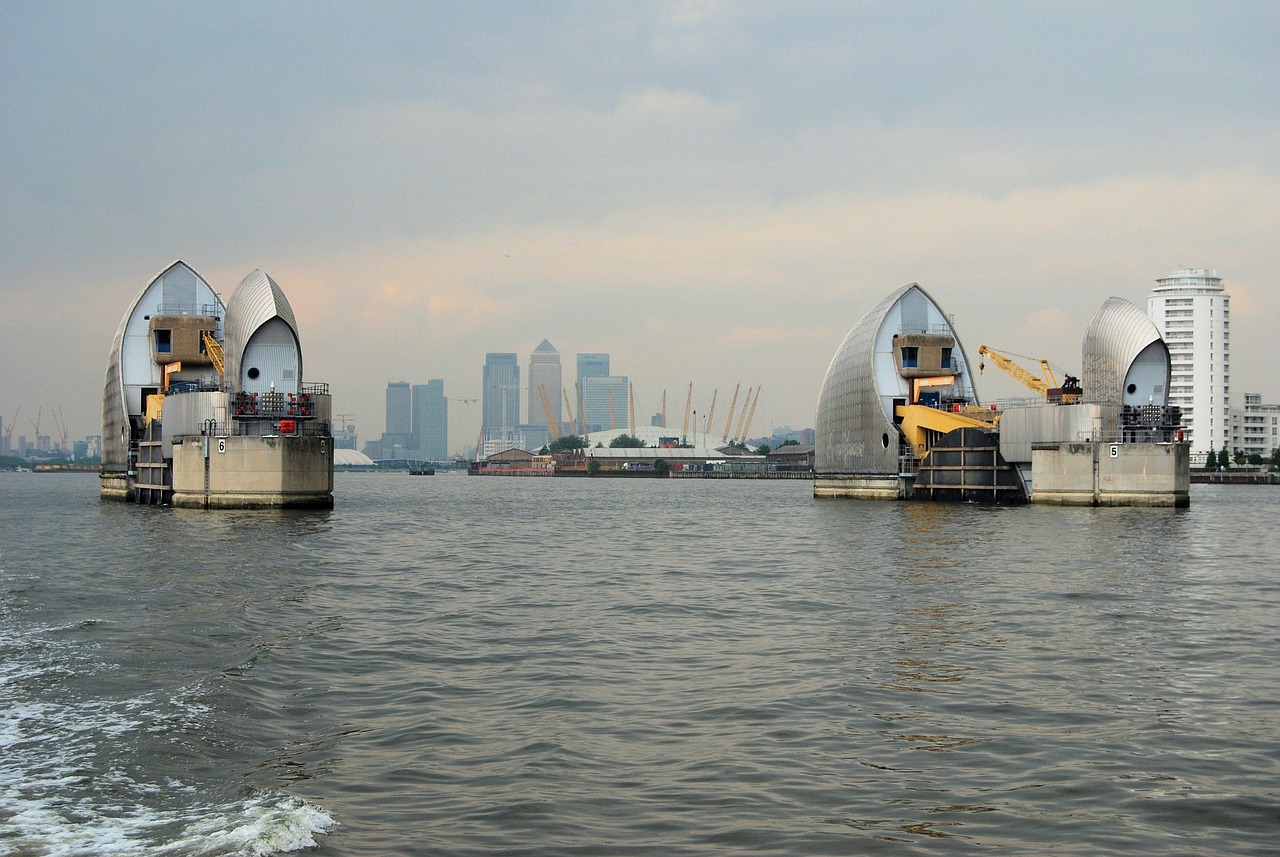
The barrier comprises ten steel gates, held between nine concrete piers and two abutments. The four main navigable gates are each 61 metres wide — sufficient for large commercial vessels to pass through — and weigh approximately 3,700 tonnes each. The six smaller gates close the remaining gaps. When raised, each main gate stands as high as a five-storey building above the riverbed. The total weight of steel in the gates exceeds 40,000 tonnes. Each gate rests in a concrete sill formed with a curvature precisely matching the gate's radius, the manufacturing tolerance on the sill curvature reportedly within 10 millimetres across the full 61-metre span.
The construction itself was a decade-long undertaking that began in 1974 and was completed in 1984. The challenges were formidable. The concrete piers had to be founded on the London Clay beneath the riverbed, requiring cofferdams and extensive dewatering. The gates were fabricated in sections at workshops across the country — the main gate sections at Cleveland Bridge in Darlington, the operating arms at Markham & Co in Chesterfield — and transported to Woolwich for assembly. Working in the tidal Thames meant that many operations could only be performed during specific tidal windows. The construction workforce peaked at over 4,000 people.
The nine piers that separate the gates are architectural as well as structural. Clad in stainless steel, their distinctive curved rooflines — like a row of ships' hulls upturned on the riverbank — were designed by the GLC's architect, and have become one of London's most recognisable silhouettes. The piers house the hydraulic machinery, the electrical systems, the control equipment, and the maintenance access for each gate. Each pier is, in effect, a self-contained operating station.
The Decision No One Wanted to Make
The Thames Barrier was officially opened by Queen Elizabeth II on 8 May 1984, thirty-one years after the flood that inspired it. The total cost was £534 million — more than five times the original estimate, though much of the overrun was attributable to the rampant inflation of the 1970s rather than to engineering failures. The barrier was designed to protect London against a 1-in-1,000-year surge tide, with an operational life extending to approximately 2030. At the time of its opening, some questioned whether the investment was justified. London had not flooded catastrophically since 1953. The threat felt abstract. The cost was concrete.
This was the central paradox of the Thames Barrier, and it remains the paradox of all preventive infrastructure. The case for building it rested on a disaster that had not yet happened. The 1953 flood had been bad, but London had survived. Critics argued that raising the embankments — a simpler, cheaper approach — would have been sufficient. Supporters countered that embankment raising was a temporary measure that would need to be repeated indefinitely as sea levels rose, and that the disruption to London of repeatedly raising walls through the heart of the city would eventually become unacceptable.
The Thames Barrier is a monument to a peculiar kind of political courage: the decision to spend enormous sums of public money to prevent a disaster that most voters had never experienced and preferred not to imagine.
Stuart Gilbert and Ray Horner, "The Thames Barrier," Thomas Telford, 1984
The argument, ultimately, was about discounting the future. How much should the present generation pay to protect future generations against a threat that is statistically certain but temporally uncertain? Hermann Bondi's cost-benefit analysis had provided the mathematical framework, but the political decision required something beyond mathematics. It required a willingness to commit vast public resources against a threat that most voters could not see, could not feel, and preferred not to think about. In an era of competing demands — housing, healthcare, education, defence — the barrier consumed resources that could have been spent on visible, immediate needs.
What made the Thames Barrier remarkable in the history of infrastructure is not that it was built. Many large infrastructure projects are built. What made it remarkable is that it was built before the crisis it was designed to prevent. The 1953 flood prompted the decision, but the barrier was not a response to an ongoing emergency. It was a response to a future certainty. London had not flooded catastrophically. The barrier was built to ensure it never would. This is vanishingly rare in the history of public infrastructure. Governments, democracies especially, are reactive. They build hospitals after epidemics, sea walls after floods, regulations after explosions. The Thames Barrier was built before.
The Future That Arrived
In the first decade after its opening, the barrier was raised relatively infrequently. Between 1984 and 1990, it was closed against surge tides just four times. Critics pointed to the low activation rate as evidence that the barrier had been an over-engineered, over-costly response to a manageable risk. But the engineers who had designed it, and the scientists who had studied the North Sea's behaviour, knew that the frequency of activation would increase. They had built that expectation into the design.
They were right. In the 1990s, the activation rate began to climb. Between 1990 and 2000, the barrier was raised 24 times. Between 2000 and 2010, it was raised 75 times. In the winter of 2013-14 alone, the barrier was closed 50 times — more than in its first sixteen years of operation combined. The surge tide of 5 December 2013 produced the highest water level recorded in the Thames since the barrier became operational, and was estimated to be comparable in magnitude to the 1953 event. London did not flood. The barrier held.
The acceleration in closures reflected exactly the trends that Bondi and his colleagues had predicted in the 1960s. Mean sea levels in the Thames Estuary had risen by approximately 15 centimetres since the barrier was designed. Isostatic subsidence continued. But there was an additional factor that the original designers had not fully anticipated: climate change. The warming of the global ocean and the accelerating loss of polar ice were raising sea levels faster than the mid-twentieth-century projections had assumed. Storm patterns were shifting. The frequency of North Sea storm surges was increasing. The Thames Barrier was not merely meeting the threat it had been designed for — it was confronting a threat that was growing faster than expected.
The barrier's original design life extended to approximately 2030, after which the Environment Agency projected that it would need to be replaced or supplemented. In 2012, the TE2100 plan — Thames Estuary 2100, a century-scale flood risk management strategy — was published. It concluded that the existing barrier could, with refurbishment and modification, remain effective until approximately 2070. Beyond that, depending on the rate of sea level rise, a new barrier further downstream — possibly at Long Reach, near Dartford — might be required. The estimated cost of a replacement barrier: several billion pounds. The TE2100 plan represented a remarkable act of institutional foresight: a government agency planning publicly for a threat that would not fully materialise for decades.
The value of the assets protected by the barrier is almost incomprehensible. Central London's flood plain contains approximately £275 billion worth of property and infrastructure, the Houses of Parliament, the Tube network, major hospitals, financial districts, and over 1.4 million residents. A catastrophic surge flood — the kind that the barrier prevents — would cause damage measured not in billions but in tens of billions of pounds, with economic disruption extending far beyond the directly flooded area. The Tube, much of which runs below the level of a major surge tide, would be inundated. Power stations along the Thames would be knocked offline. Sewage systems would fail. The cascading effects would paralyse the national economy.
This is the arithmetic that vindicates the barrier. The £534 million spent on its construction — approximately £2.4 billion in 2024 terms — has protected a quarter of a trillion pounds of assets through more than 200 surge closures. The cost-benefit ratio is not close. It is overwhelming. But this arithmetic was only available in hindsight. At the time the decision was made, it required faith — faith in the science, faith in the engineering, and faith in the proposition that spending enormous sums of money to prevent an invisible future disaster was a legitimate use of public resources.
What the Barrier Teaches
The Thames Barrier story is unusual in the canon of engineering post-mortems because there is no disaster at its centre. Nobody died. Nothing collapsed. No investigation was convened, no blame assigned. This is, in fact, precisely the point. The Thames Barrier is the story of a disaster that did not happen because, for once, the engineering was done first.
Most of the episodes in this series follow a common pattern. Something fails. People die. An investigation discovers that the failure was predictable, often predicted, and that the warnings were ignored or discounted until the disaster made them undeniable. The Buncefield explosion happened because a gauge stuck and a switch failed. Chernobyl happened because a safety test was conducted without understanding the reactor's behaviour. Piper Alpha happened because a permit-to-work system broke down. In every case, the disaster was the forcing function for change. The lessons were written in wreckage.
The Thames Barrier reverses the pattern. The 1953 flood was the warning. The warning was heeded. Not quickly — nineteen years elapsed between the Waverley Committee and the enabling legislation, and another twelve years between the start of construction and completion. But it was heeded. The barrier was built. And when the floods came, as the mathematics said they would, London was protected. Over two hundred times.
- The 1953 North Sea flood killed 307 people in England and prompted the Waverley Committee's recommendation for a Thames barrier.
- Hermann Bondi's 1967 cost-benefit analysis transformed the barrier from a desirable project into an actuarial necessity.
- Charles Draper's rising sector gate design solved the fundamental paradox: immense strength when closed, invisible when open.
- Construction at Woolwich Reach took ten years (1974-1984) and cost £534 million — more than five times the original estimate.
- The barrier has been activated over 200 times, with the rate of closures accelerating as sea levels rise.
- The TE2100 plan extends London's flood defence strategy through the end of the century, committing to decision points decades in advance.
The lesson is uncomfortable for anyone who manages complex systems, because it is a lesson about spending money against invisible threats. Risk managers understand the concept theoretically. They calculate expected losses, assign probabilities, multiply the two, and compare the result against the cost of mitigation. But there is a profound difference between performing this calculation in a spreadsheet and performing it in a democratic political system where the money belongs to taxpayers who can see the hospital that was not built, the school that was not funded, the tax that was not cut — and cannot see the flood that did not happen.
The Thames Barrier was built because a specific combination of factors aligned: a devastating flood that killed hundreds, a mathematical analysis that made the case unanswerable, an engineering design that solved the technical problem elegantly, and — perhaps most critically — enough political leaders who were willing to commit to an expenditure whose benefits would accrue primarily to future generations. Remove any one of those factors, and the barrier might never have been built. London might have continued raising its embankments, adding a few centimetres each decade, hoping that the next surge would not be the one that overtopped them.
Infrastructure built for a future that actually arrived is vanishingly rare. The Thames Barrier stands as proof that it is possible — and as a rebuke to every government and institution that waits for the disaster before acting.
The Netherlands, galvanised by the same 1953 flood, embarked on the Delta Works — a system of dams, storm surge barriers, and flood defences that took thirty years to complete and remains one of the most ambitious hydraulic engineering programmes in human history. Both nations responded to the same disaster with massive infrastructure investment. Both investments have been vindicated by subsequent events. The contrast with nations and cities that continue to defer flood protection, building in flood plains and relying on insurance rather than engineering, is stark.
The Thames Barrier is now forty years old. Its stainless-steel piers still gleam at Woolwich Reach, and the hydraulic machinery still rotates each gate through its 90-degree arc when the Environment Agency's forecasters detect a dangerous surge forming in the North Sea. It is infrastructure that works. It is infrastructure that was built for a future that arrived. And the lesson it offers — that prevention is possible, that foresight can be funded, that the invisible disaster averted is worth more than the visible disaster survived — remains as difficult, and as necessary, as it was in 1953.
Sources
- Waverley Committee Report on Coastal Flooding, 1954 — https://wellcomecollection.org/works/x2rqf8aw
- Bondi Report on London Flood Risk, 1967 — https://discovery.nationalarchives.gov.uk/details/r/C281
- Gilbert & Horner — The Thames Barrier (Thomas Telford, 1984) — https://www.icevirtuallibrary.com/doi/book/10.1680/ttb.01711
- TE2100 Plan — Thames Estuary 2100 — https://www.gov.uk/government/publications/thames-estuary-2100-te2100
- Baxter, P.J. — The East Coast Big Flood (2005) — https://doi.org/10.1098/rsta.2005.1592
- Horner, R.W. — The Thames Barrier Project (1979) — https://doi.org/10.1111/j.1475-4762.1979.tb01110.x
- Environment Agency — Thames Barrier Closures — https://www.gov.uk/guidance/the-thames-barrier